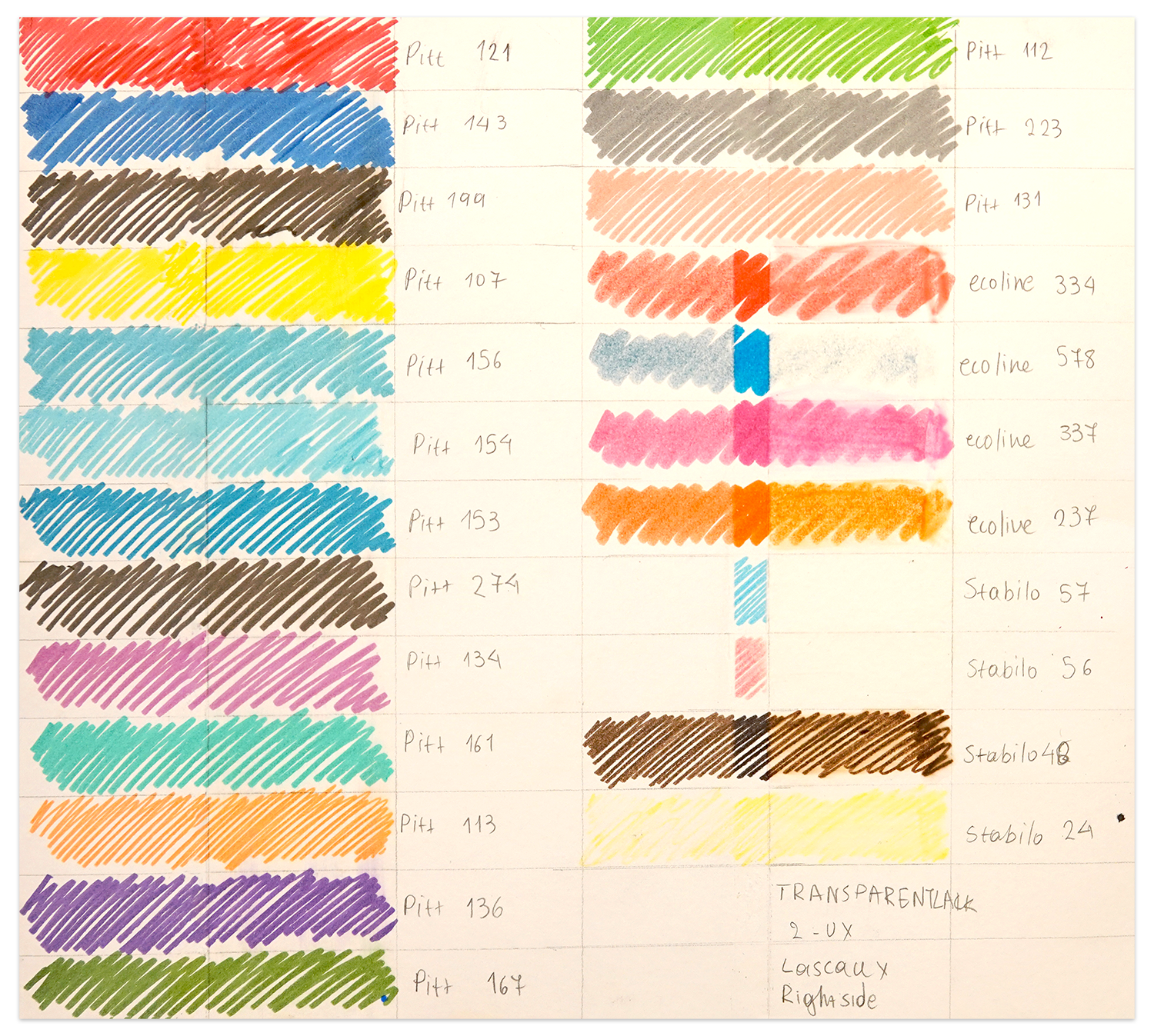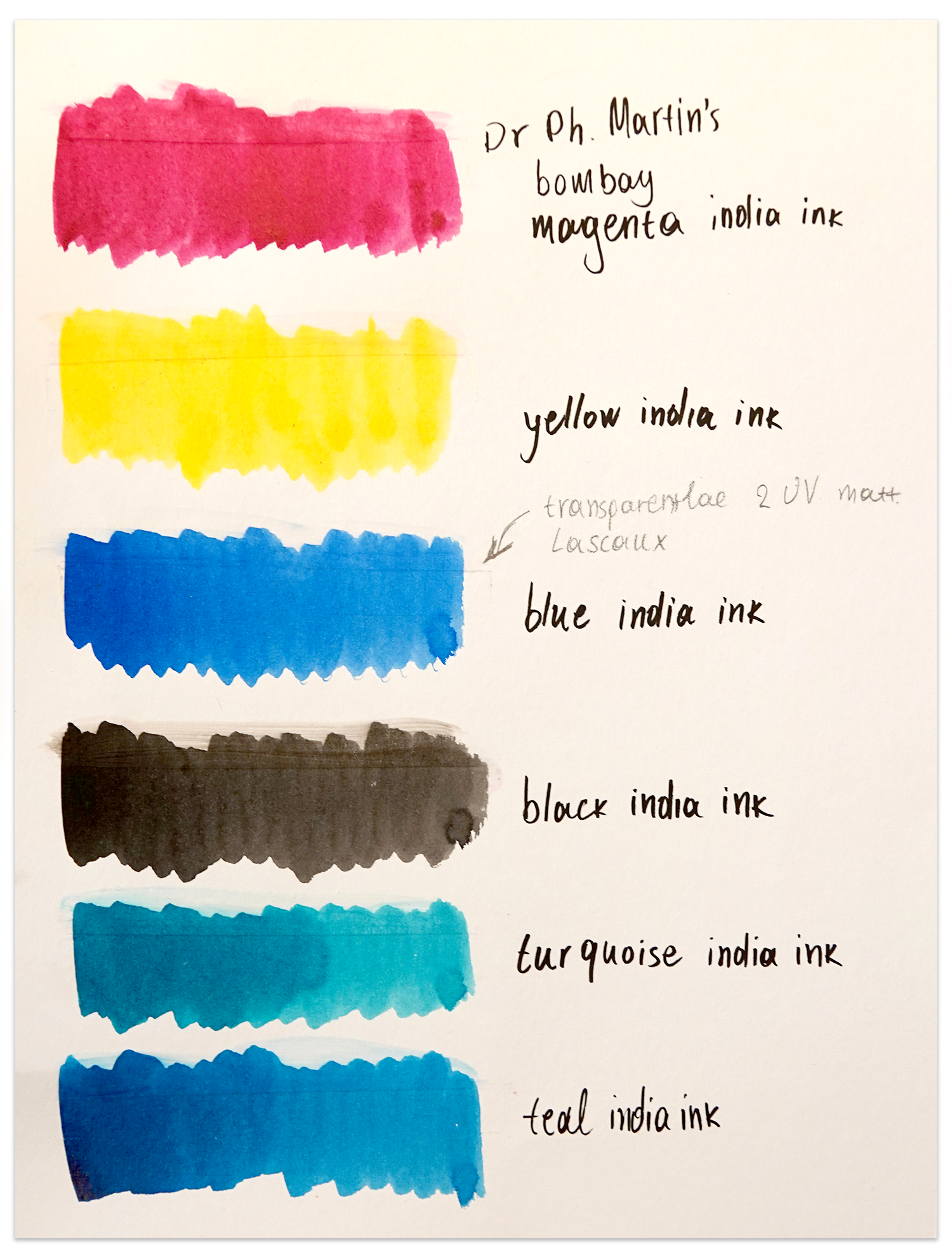

Initially, a lot of markers appeared promising due to their broad palette and the availability of both fineliners and felt markers ready for use, which allowed for varying line widths that are ideal for Chromatron. Realising that these products don't provide lightfastness information, we decided to test the markers ourselves.
The test process proved to be lengthy and sometimes frustrating, as many products that initially seemed appropriate ultimately failed to meet our standards for lightfastness, vibrance, and colour range. Despite these challenges, ongoing testing has led us to identify several products that meet our high requirements.
We tested a variety of markers and inks by creating swatches on paper, which were then placed by a southwest facing window for six months. This location receives direct sunlight from around noon until sunset, typically totaling six or more hours of exposure each day. The test will be completed after a full year of light exposure.
A list of markers, acrylics and inks we tested:
Failed lightfastness test, they are one of the first to fade during our tests. It is not meant for artworks, works fine as a fineliner/marker for casual use.
Failed lightfastness test, fades rapidly. It is not meant for artworks, works fine as a fineliner for casual use.
Pantone Talens provides a huge range of high-quality pigment inks that correspond to the Pantone colour system and are lightfast. Unfortunately, they only work as intended when they are applied on Pantone paper. Within the context of Chromatron this is a problem for a couple of reasons. These papers go up to A3 standardised paper size, which is rather small. Also, the weight of the paper is 180g, which we find too thin for works of art. We were not able to swab properly on our preferred papers (all of archival grade), the colours were either too dark or lacking vibrance. In our opinion, Pantone should make it more explicit that these colours only work on their own specific paper, although they do mention it in the frequently asked questions.
These products are nice, easy to use and with beautiful, vibrant colours like all dye-based colours. Unfortunately, due to the nature of the dye, they are not recommended as they fail the lightfastness test.
Failed lightfastness test, they were the first to go. Clearly, they are not meant for artworks. They might work fine as a casual pen but maybe you should not sign important documents with it.
Failed lightfastness test, fades rapidly. It is not meant for artworks, works fine as a casual pen though.
Failed lightfastness test, fades rapidly. It is not meant for artworks, works fine as a casual pen though.
We have been using Golden acrylics for years, and they are one of the best archival-grade paints in the market. They provide a large range of colours and they are reliable and a pleasure to work with. We can highly recommend them and we are working in incorporating them in the future.
This ink offers a good palette of vibrant colours. The lightfasteness test proved that it is a highly lightfast and relable ink that also works great with our refillable markers. We are very confident that we have made the right choice to offer this India ink for Chromatron.
High-pigmented and lightfast, the brand offers refillable markers in different sizes. A pleasure to work with.
India ink and a huge range of colours, lightfast and reliable. It comes in a marker with a brush. We only wish that at some point they would offer the inks themselves and refillable markers separately.
These pens offer a variety of colours, suitable for artwork that needs to maintain its vibrancy over time, even when displayed or exposed to light. Unfortunately, they are markers for one-time-use, but at least Staedtler claims that they are made of 97% recycled plastic. Same as with the Faber Castell markers, we wish they would sell the ink and refillable markers separately. Hopefully, both they will provide with spare tips and refillable solutions soon.
All markers that failed the test have no claims over lightfastness so, technically, none of the manufacturers stated anything that is not true.
Following are a selection of samples and results we obtained for the lightfastness tests. Rectangles were hatched and partly covered. They were exposed to direct normal daylight for a few days. If you see differences in the color intensity within a rectangle then the pigments have degraded in the uncovered areas.